
The base under the grass
Yard Grading & Topsoil in Philadelphia, PA
Rough and fine grading, new topsoil and drainage fixes before we seed.
- We visit the property and put the price in writing at no charge
- Quotes list prep, seed mix, mulch and erosion controls separately
- Seed mixes picked for your sun, shade and soil
Get the Grade Right, Then Seed
Yard grading and topsoil work in Philadelphia is the dirt work underneath a new lawn, and it largely settles whether that lawn thrives or struggles. A seed mix can only do so much on compacted fill, a skim of topsoil or ground that pitches water back toward the foundation. We handle rough and fine grading, topsoil delivery and spreading, small drainage corrections and seedbed preparation, so the lawn goes onto ground that is ready for it. When a drainage fix calls for digging, such as burying downspout lines or cutting a swale, the same grading crew does the excavation and trenching.
What good grade looks like
Penn State Extension recommends that the finished grade slope gently away from a building at 1 to 4 percent, a 1 to 4 foot drop over 100 feet, with no low spots where water can stand. On houses built into hillsides it calls for drainage swales around the building. Rough grading is done on subsoil before topsoil goes back, with the subgrade set low enough to allow for the topsoil depth.
How much topsoil
Penn State advises a minimum of 4 to 6 inches of good topsoil, measured firmed or settled, for good-quality turf, and ideally working about 2 inches of it into the top 2 to 3 inches of subsoil so there is no sharp layer where water perches. New construction lots around the region often fall short of that. The builder strips the topsoil, the lot gets driven over for months, and only a thin layer goes back. We measure depth on the site visit and quote what it takes to reach a real lawn base.
Compaction
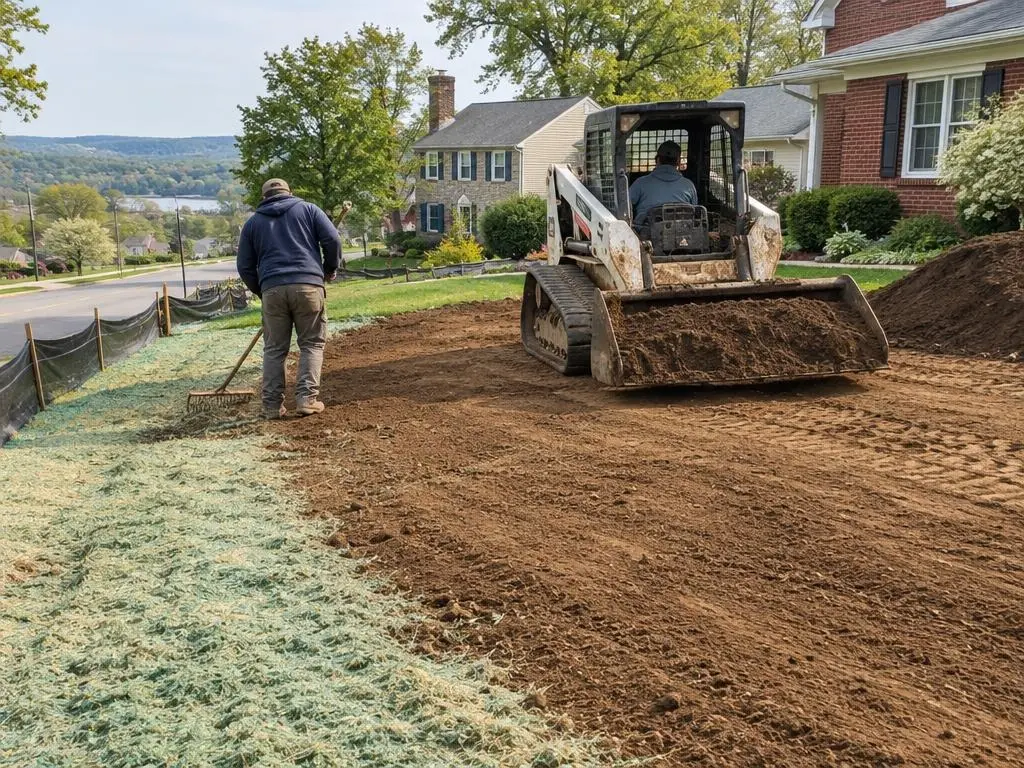
Construction traffic packs subsoil hard. Penn State notes that a bulldozer with a ripper can break severely compacted ground, and a chisel plow can loosen lightly compacted soil. On residential lots we use the right-sized equipment for access: compact track loaders on suburban lots, smaller machines and hand work on rowhouse yards reached through a gate or alley.
Local soils and grading
On the Piedmont side of the Fall Line, silt loam soils like the Chester series sit over silty clay loam subsoil, with bedrock usually 6 to 10 feet or more down. They grade well when dry but turn slick and smear when worked wet, so we watch the weather. In parts of Montgomery County, shale soils have bedrock much closer to the surface, which limits how much we can cut. Along the river and in South Jersey, sandy soils grade easily but need organic matter to hold water for new grass.
Fine grading and seedbed prep
After rough grade and topsoil, fine grading firms and smooths the surface. Penn State describes dragging a heavy mat or using a light roller or cultipacker when the soil is fairly dry, and removing stones larger than 2 inches. Lime and phosphorus and potassium, if the soil test calls for them, are worked into the top 4 to 6 inches at this stage, while nitrogen goes on at seeding as starter fertilizer.
Land grading for larger lots
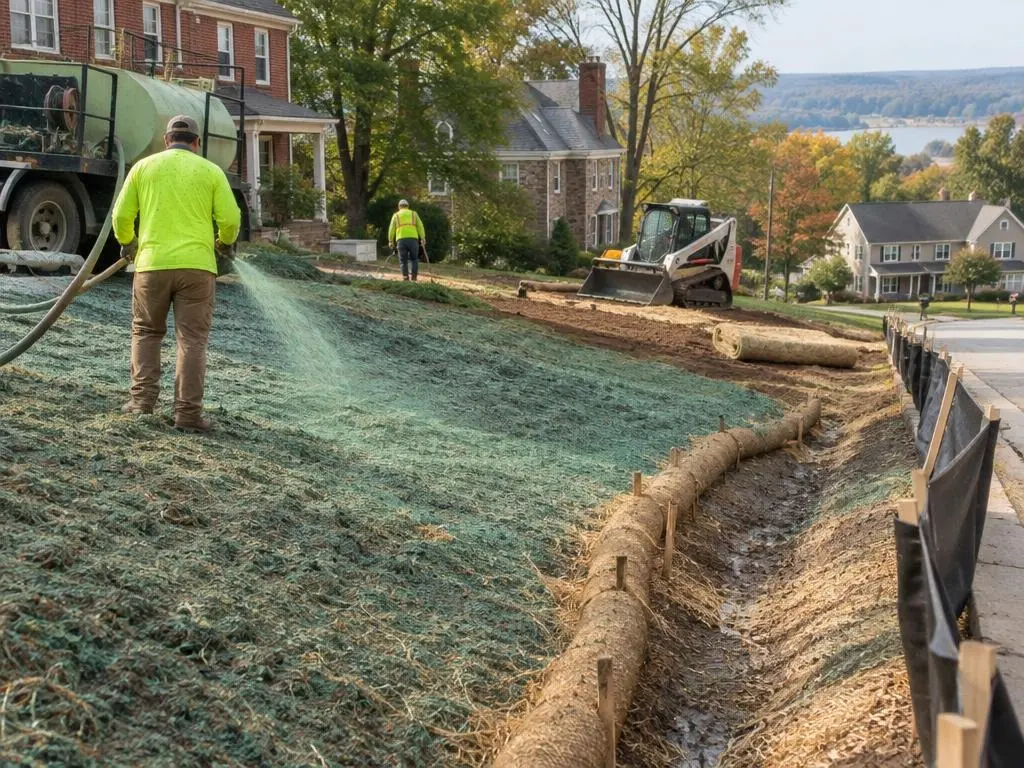
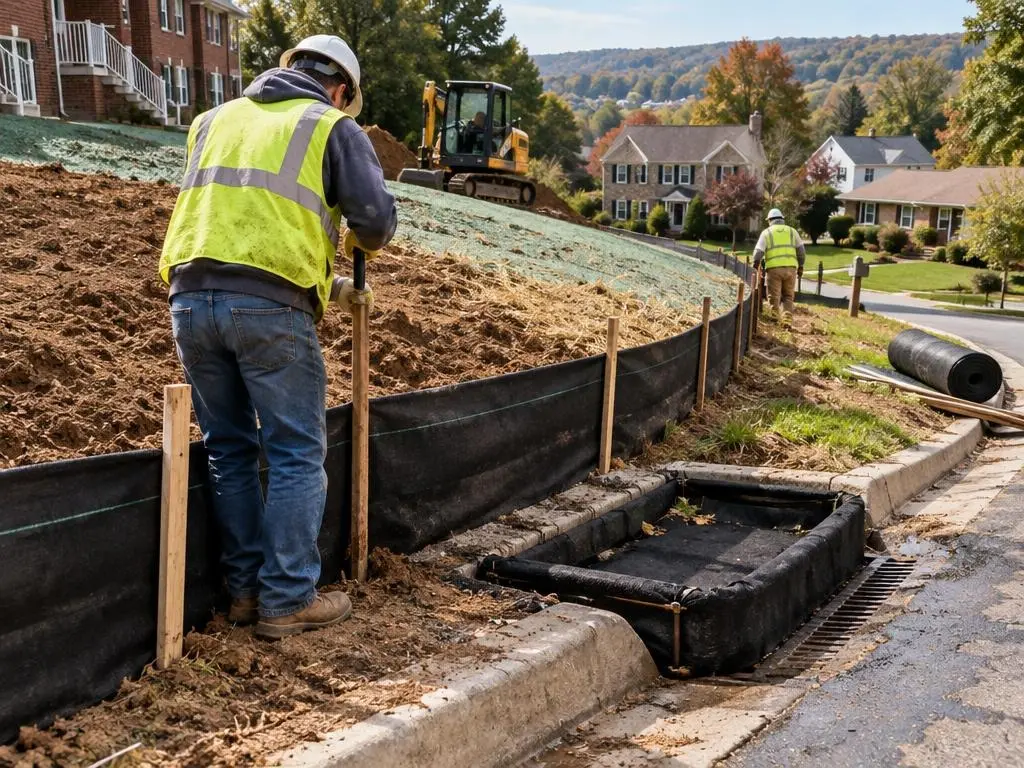
For larger properties and builder lots we do land grading to plan: setting grades to stakes, shaping swales and berms, and spreading stockpiled topsoil. Once more than 5,000 square feet of ground is disturbed inside Philadelphia, the Water Department requires an Erosion and Sediment Control Plan, and controls are required on any size of job, so we set silt fence or sock before we start moving dirt.
Grading and Soil Work
Everything under the seed.
Rough grading
Shaping subsoil to set drainage away from the house and remove low spots.
Topsoil delivery and spreading
Screened topsoil spread to a settled depth of 4 to 6 inches or more.
Fine grading
Smoothing, firming and stone removal for an even seedbed.
Compaction relief
Ripping or tilling compacted construction subsoil.
Drainage swales and trenching
Shallow swales, buried downspout lines and small excavation for drainage.
Soil amendments
Lime, compost and fertilizer worked in per the soil test.
Grading and Topsoil Price Ranges
| Work | Published range (source) |
|---|---|
| Lawn leveling per sq ft (HomeAdvisor) | $1 to $2 |
| Regrade or reslope a lawn, typical range (HomeAdvisor) | $1,021 to $3,331 |
| Fine grading per sq ft (Lawn Love) | $0.08 to $1.00 |
| Topsoil per cubic yard, material (HomeAdvisor) | $12 to $55 |
| Angi: topsoil delivery for a load up to 15 cu yd | $50 to $150 |
| Grading labor per hour (HomeAdvisor) | $50 to $100 |
National published ranges, not Philadelphia pricing. Access, soil, depth and haul distance shift the total; the figure on our signed quote is the one you pay.
How Grading Jobs Run
1. Measure and probe
Check existing grade, topsoil depth, compaction and drainage paths.
2. Estimate
Grading, topsoil volume and seeding as separate lines.
3. Set controls
Silt fence or sock on the low side before dirt moves.
4. Rough grade and topsoil
Shape the subgrade, loosen it and spread topsoil.
5. Fine grade and seed
Smooth, firm and hydroseed or hand off to your schedule.
Why Choose Us for Yard Grading & Topsoil
Topsoil measured, not guessed
We probe depth and quote the cubic yards it takes.
Grade and seed in one plan
No gap between the dirt crew and the seeding crew.
Small-access equipment
Machines sized for side yards and city lots.
Yard Grading & Topsoil Questions
What depth of topsoil does a new lawn in Philadelphia need?
Penn State recommends at least 4 to 6 inches of good topsoil, firmed or settled. At 4 inches, 1,000 square feet takes about 12 cubic yards before settling, so plan a bit more.
How do I know if my yard drains toward the house?
Watch where water goes in a heavy rain or lay a long level on the ground. Grade should fall 1 to 4 percent away from the foundation, and standing water near the house means it does not.
Do you do excavation and trenching for drainage?
Yes, for yard drainage: swales, buried downspout extensions and shallow trenches tied to grading. Larger excavation is coordinated with an excavation contractor.
Can you grade when the ground is wet?
We avoid it. Silt loam soils smear and compact when worked wet, which hurts drainage and root growth later.
Yard Grading & Topsoil Service Areas
- Hydroseeding in Philadelphia, PA
- Hydroseeding in Doylestown, PA
- Hydroseeding in Newtown, PA
- Hydroseeding in Warminster, PA
- Hydroseeding in Bensalem, PA
- Hydroseeding in Levittown, PA
- Hydroseeding in Lower Makefield, PA
- Hydroseeding in Horsham, PA
- Hydroseeding in Lansdale, PA
- Hydroseeding in Montgomery Township, PA
- Hydroseeding in Whitpain Township, PA
- Hydroseeding in Upper Merion, PA
- Hydroseeding in West Chester, PA
- Hydroseeding in Phoenixville, PA
- Hydroseeding in Downingtown, PA
- Hydroseeding in Upper Providence, PA
- Hydroseeding in Cherry Hill, NJ
- Hydroseeding in Warrington, PA
- Hydroseeding in Concord Township, PA
- Hydroseeding in Newtown Square, PA
- Hydroseeding in Northampton Township, PA
- Hydroseeding in Evesham Township, NJ
- Hydroseeding in Upper Dublin, PA
Get a Yard Grading & Topsoil Estimate
Free grading and topsoil estimates in the Philadelphia area.