Fall Line lawns and slopes
Hydroseeding in Philadelphia, PA
New lawns, bank stabilization and site seeding for city yards, suburban lots and builders across the Delaware Valley.
- We visit the property and put the price in writing at no charge
- Quotes list prep, seed mix, mulch and erosion controls separately
- Seed mixes picked for your sun, shade and soil
Grass on Bare Ground, Done for This Region
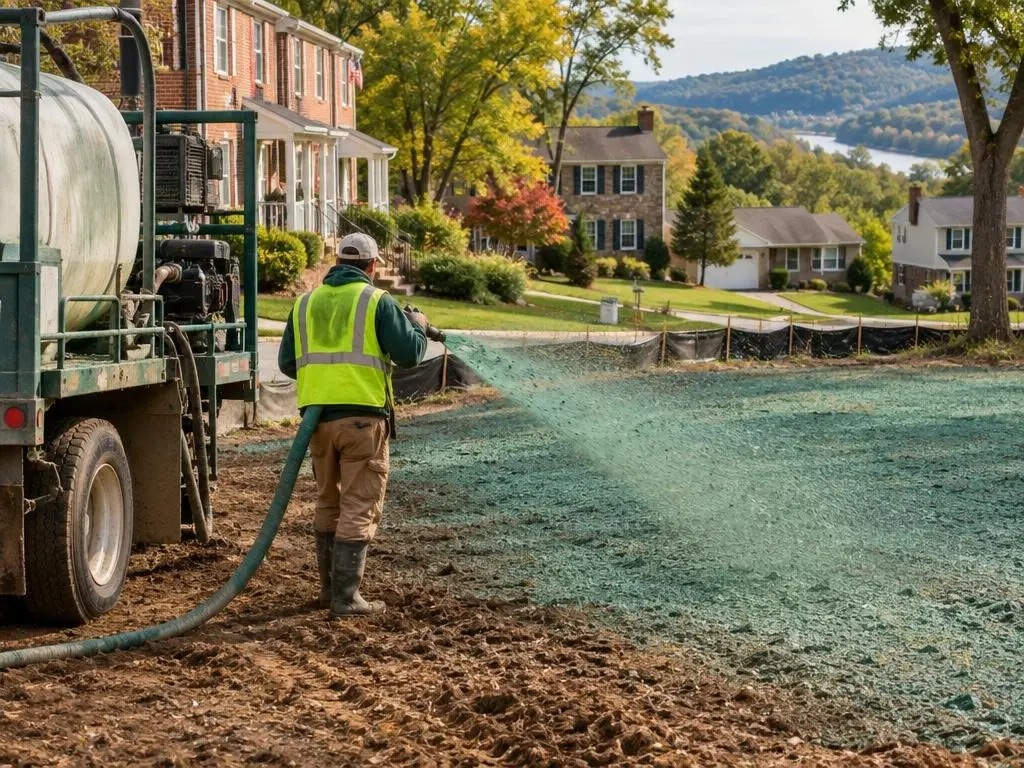
Hydroseeding in Philadelphia is how we put grass on ground that has just been graded, dug up or stripped bare: new construction lots, rebuilt back yards, regraded side slopes and the raw strips left after utility and drainage work. We mix seed, wood fiber mulch, starter fertilizer, tackifier and water in one tank and spray it onto a prepared seedbed, so the seed lands already covered and held in place. We work across the city and the suburbs in Bucks, Montgomery, Chester and Delaware counties and nearby South Jersey, on everything from a narrow rowhouse yard to several acres of builder's ground.
Two kinds of ground meet here
Philadelphia sits on the Atlantic Seaboard Fall Line, the boundary between the hilly Piedmont and the flat Atlantic Plain. That line shows up in the dirt. Northwest of it, on the uplands toward Chestnut Hill, Montgomery County and Chester County, soils like the Chester series weather from micaceous schist. The USDA describes them as well drained, with a silt loam or loam surface over a silt loam to silty clay loam subsoil that turns yellowish red as you dig down. Slopes on those soils range from nearly flat to 65 percent. Southeast of the Fall Line, along the Delaware River and across into Camden and Burlington counties, the ground gets sandier and flatter. Sandy soil drains fast and dries out a seedbed in a day; silty Piedmont soil holds water but crusts and washes on a slope. We adjust mulch rate, seed mix and watering advice to the side of the line your yard is on.
Weather that shapes the seeding calendar
The city's climate is on the northern edge of humid subtropical. Average precipitation is about 44.1 inches a year, January averages 33.7 degrees and July about 78.7, and highs reach 90 or more on about 30 days a year. The average freeze window runs from November 6 to April 2, a growing season of about 217 days. Lawns here are cool-season grasses: turf-type tall fescue, Kentucky bluegrass, perennial ryegrass and the fine fescues for shade. Penn State Extension says the optimum times to seed turf in Pennsylvania are mid to late spring and late summer to early fall, and that late summer is the strongest window because late August and early September soils are warm and dry enough to work, and seedlings get both fall and spring to root before their first summer. Summer seedings face heat, drought and disease, and seed will not germinate once soil turns cold in late fall.
So our busiest stretch is mid-August into early October. Spring work is fine, especially for construction sites that cannot wait, but a spring lawn has to be watered harder through its first July.
Hydroseed, sod or dry seed
There are three ways to get grass on bare ground, and each has a place.
- Sod gives you a finished lawn the day it goes down and can be laid almost any time the ground is not frozen. Penn State calls it usually the most expensive way to establish cool-season grass, and Kentucky bluegrass is the common sod species in Pennsylvania, which is not the right grass for heavy shade. Installed sod, by HomeGuide's numbers, costs $1 to $4 per sq ft.
- Dry seed with straw is the cheapest route on a small, flat patch. Straw is the most widely used and least expensive lawn mulch, but it blows around, brings some weed seed and has to be spread at the right rate.
- Hydroseed sits between them. The University of Nebraska Extension puts its price slightly above dry seeding and, as a rule, below sodding, and says hydroseeded grass generally becomes visible in 5 to 7 days, where dry-sown seed takes two to three weeks. HomeGuide lists hydroseeding at $0.12 to $0.35 per sq ft. Penn State notes it is most efficient on large areas and steep slopes, which is where it earns its keep around here.
Stormwater rules in the city
Parts of Philadelphia are served by combined sewers, where rain and sewage share the same pipes, and the Water Department's rules aim to keep sediment out of them. Its stormwater manual says all earth disturbance must meet Pennsylvania DEP erosion and sediment control requirements, that projects with 5,000 square feet or more of disturbance must submit an Erosion and Sediment Control Plan, and that every project, regardless of size, must install controls suited to the site. City-owned inlets that take runoff from a work site must be protected, and silt fence must be trenched in and backfilled to work. State rules then decide when a site is finished: 25 Pa. Code 102.22 counts ground as permanently stabilized only when it has a uniform 70 percent perennial vegetative cover or another approved practice, and it requires seeding or mulching right away when work stops for more than 4 days. That is why builders and site contractors call hydroseeding contractors at the end of a job: the grass is what lets the silt fence come down.
Topsoil and grade come first
Most failed lawns we see were seeded on the wrong base. Penn State recommends a minimum of 4 to 6 inches of good topsoil, firmed or settled, and a finished grade that falls 1 to 4 percent away from the house. Construction subsoil is usually compacted and needs ripping or tilling before topsoil goes back. A soil test, taken three to four weeks ahead, tells you how much lime and fertilizer the ground needs. We can handle the yard grading, topsoil and dirt work ourselves, or seed behind your excavator once the grade is set.
Slopes, creek banks and wooded lots
The region is full of creek valleys: the Wissahickon, Pennypack and Cobbs creeks inside the city, and the Neshaminy, Perkiomen and Brandywine systems in the suburbs. Fairmount Park and the Wissahickon Valley Park together cover more than 4,000 acres. Homes that back onto those valleys come with steep banks, shade and runoff from uphill neighbors. A light lawn mix will not hold there. We raise the hydromulch rate, add tackifier, use erosion control blankets on the steepest pitches and pick shade-tolerant fescues where tree cover is heavy.
What happens after we spray
The first 4 to 8 weeks decide whether a new lawn makes it, and Penn State says more seedings fail from poor follow-up care than from anything else. Expect light, frequent watering so the surface stays moist, first germination in about a week in warm soil, and a first mow once the grass reaches about 4 inches, roughly six weeks out according to Angi. Keep foot traffic, dogs and equipment off it. We leave written instructions and answer questions by phone while it fills in.
Our Services
Six services that take a site from raw dirt to a stable, growing lawn.
Hydroseed Lawn Installation
New lawns sprayed onto prepared topsoil after construction, regrading or a full yard rebuild.
Learn more →Commercial & Builder Hydroseeding
Large-area seeding for developers, site contractors, schools and public projects that need stabilized ground.
Learn more →Slope Stabilization & Erosion Control
Banks, swales and ditches held in place with hydromulch, bonded fiber matrix, or straw and coir blankets rolled onto the ground.
Learn more →Silt Fence & Inlet Protection
Sediment control for permitted sites and home projects, from silt fence installation to inlet protection.
Learn more →Yard Grading & Topsoil
Dirt work, yard grading, land grading and topsoil so new seed has the right base and water drains away.
Learn more →Lawn Renovation & Overseeding
Lawn repair, renovation and overseeding for thin, patchy or worn lawns that do not need a full rebuild.
Learn more →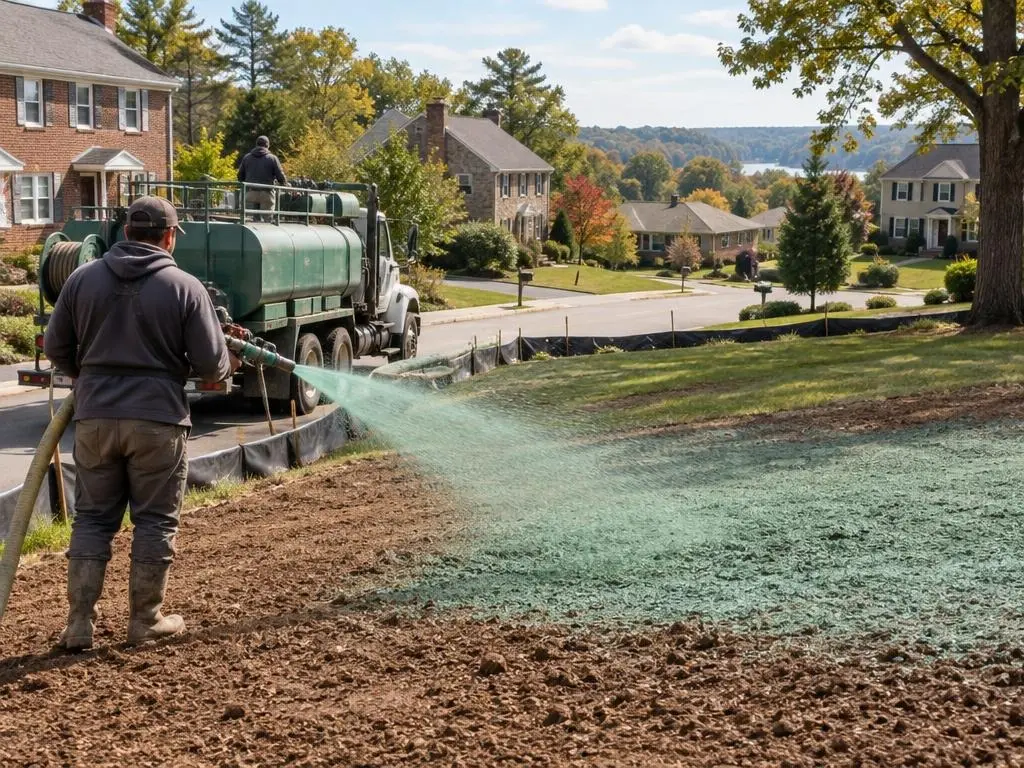
Common Questions
Is there a downside to hydroseeding?
Yes. A hydroseeded lawn is not finished on day one the way sod is, it needs steady watering for several weeks, and it has to stay off-limits to kids, dogs and equipment while it fills in. It also costs more than spreading dry seed yourself. In exchange you get faster, more even germination than dry seed at a lower price than sod, and mulch that holds seed on slopes.
What part of the year should a Philadelphia lawn be hydroseeded?
Late August through September is the strongest window. Penn State Extension names late summer as the optimum time to seed cool-season grass in most of Pennsylvania, with mid to late spring second. Summer seedings fight heat and disease, and seed stops germinating once the soil turns cold in late fall.
How much does hydroseeding cost?
Published national figures run from about $0.06 up to $0.35 a square foot, varying by guide. HomeGuide prices a 5,000-square-foot yard at $1,000 to $1,750. Minimum job charges of $300 to $500 are common. Grading, topsoil and slope work show up as separate lines, and once you approve our written estimate, its bottom line is your bill, with no add-ons later.
What grass do you spray around here?
Cool-season mixes. For sunny, well-drained yards that is usually turf-type tall fescue or a Kentucky bluegrass and perennial ryegrass blend; for shade, fine fescues lead the mix. We pick the mix after seeing the site.
Can you hydroseed a small rowhouse yard?
Often, yes. The hose can run through an alley, a side gate or sometimes through the house with protection, so the truck does not need to reach the yard. On very small patches dry seed may cost less, and we will say so.
Do I need a permit or an E&S plan to seed my yard?
Seeding a lawn by itself usually does not. Philadelphia Water requires an Erosion and Sediment Control Plan when a project disturbs 5,000 square feet or more, and every project must use controls suited to the site. If your grading or construction triggers a plan, we work to it.
How soon can I mow and walk on a hydroseeded lawn?
Grass usually shows in about 5 to 7 days in warm soil. The first mow comes when it is about 4 inches tall, often around six weeks after spraying. Keep heavy traffic off for the first full season if you can.
Will hydroseed wash away in a heavy storm?
The fiber mulch and tackifier bind the seed to the soil, so it holds much better than loose seed. A cloudburst on a bare, steep slope can still cut rills, so on banks we add more mulch or an erosion control blanket and fix any washouts during establishment.
Why Homeowners Call Hydroseeding Philadelphia
We know which side of the Fall Line you are on
Sandy coastal plain ground and silty Piedmont soil need different mulch rates, seed mixes and watering.
Calendar-honest scheduling
We push for the late-summer window and tell you when a spring or late-fall job carries more risk.
One crew from grade to grass
Grading, topsoil, silt fence, blankets and seeding can all sit in one written estimate.
Built for permitted sites
We work to your approved E&S plan and the 70 percent cover standard the state uses to call a site stabilized.
Towns We Seed Around Philadelphia
We work in Philadelphia neighborhoods from Chestnut Hill to the river wards, and across four Pennsylvania counties and South Jersey. In Bucks County that means Doylestown, Warrington, Warminster, Northampton Township, Newtown, Lower Makefield, Bensalem and Levittown, where creeks like the Neshaminy shape drainage and the 1950s Levittown lots sit low and flat. In Montgomery County we cover Horsham, Lansdale, Montgomery Township, Whitpain, Upper Dublin, Upper Merion and Upper Providence, a mix of Piedmont hills, shale soils and fast-growing subdivisions. Chester County work takes us to West Chester, Downingtown and Phoenixville along the Brandywine and French Creek valleys, and Delaware County to Newtown Square and Concord Township. Across the bridges we seed in Cherry Hill and Evesham Township, where coastal plain sand drains very differently from the hills west of the city. Each town page explains what changes there.
- Hydroseeding in Philadelphia, PA
- Hydroseeding in Doylestown, PA
- Hydroseeding in Newtown, PA
- Hydroseeding in Warminster, PA
- Hydroseeding in Bensalem, PA
- Hydroseeding in Levittown, PA
- Hydroseeding in Lower Makefield, PA
- Hydroseeding in Horsham, PA
- Hydroseeding in Lansdale, PA
- Hydroseeding in Montgomery Township, PA
- Hydroseeding in Whitpain Township, PA
- Hydroseeding in Upper Merion, PA
- Hydroseeding in West Chester, PA
- Hydroseeding in Phoenixville, PA
- Hydroseeding in Downingtown, PA
- Hydroseeding in Upper Providence, PA
- Hydroseeding in Cherry Hill, NJ
- Hydroseeding in Warrington, PA
- Hydroseeding in Concord Township, PA
- Hydroseeding in Newtown Square, PA
- Hydroseeding in Northampton Township, PA
- Hydroseeding in Evesham Township, NJ
- Hydroseeding in Upper Dublin, PA
Book a Free Site Walk
Tell us about the ground and we will come look, measure and put a price in writing.