
Banks that stay put
Slope Stabilization & Erosion Control in Philadelphia, PA
Seed, heavy mulch and blankets that hold soil on steep yards, creek banks and drainage swales.
- We visit the property and put the price in writing at no charge
- Quotes list prep, seed mix, mulch and erosion controls separately
- Seed mixes picked for your sun, shade and soil
Holding Soil on Piedmont Slopes
Slope stabilization and erosion control in Philadelphia is about keeping soil where it belongs long enough for roots to take over. North and west of the city, the Piedmont breaks into creek valleys with steep wooded sides, and the suburbs are full of homes built into hillsides, regraded back yards and new swales cut to move stormwater. When those slopes are left bare, rain carries the soil off, gullies form, and the sediment ends up in an inlet or a creek. Our erosion control services cover everything from a single eroding bank behind a house to long runs of ditch and basin slope on a development site.
Why slopes here fail
Upland soils like the Chester series are silt loams over silty clay loam subsoil, weathered from mica schist. The USDA lists slopes on them from 0 to 65 percent. Silt loam sheds water as a thin sheet and then cuts rills once flow concentrates, and the subsoil exposed by grading takes seed poorly. Philadelphia averages about 44 inches of precipitation a year, with heavy summer thunderstorms, so a bare slope rarely gets a gentle first rain. Shade from mature oaks and tulip poplars on wooded lots slows grass, which leaves soil exposed even longer.
Hydromulch for moderate slopes
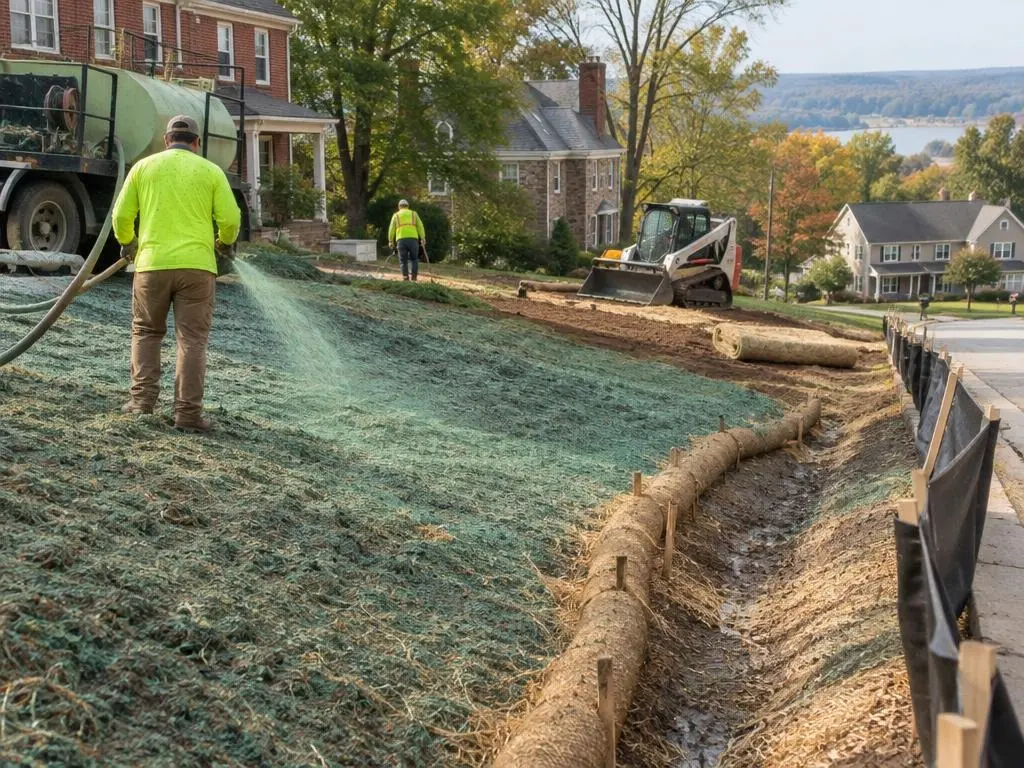
On moderate grades, a heavier hydromulching coat is often enough. Penn State Extension describes hydromulching as spraying wood fiber or paper mulch with water and a tackifier over seed and soil, and lists rates of 30 to 40 pounds per 1,000 square feet on level and gentle ground and up to 3,000 pounds per acre on steep slopes. We raise the rate and tackifier with the pitch so the mat holds through a hard storm while still letting seedlings through.
Bonded fiber matrix
Bonded fiber matrix, or BFM, is a hydraulically applied mulch with a stronger bonding agent; once cured, it forms one unbroken layer that still lets water through. It is used where a slope is too steep or too long for standard hydromulch but where blankets would be hard to anchor or install, such as rocky cuts and irregular banks. It costs more than standard fiber mulch, so we use it where the slope calls for it.
Erosion control blankets
For the steepest pitches, channel bottoms and anywhere water concentrates, we use erosion control blankets: rolled mats made of straw alone, a straw and coconut fiber mix, or pure coir, laid over seeded soil and stapled down. Straw blankets break down fastest and suit lawn-edge slopes; straw-coconut and coir blankets last longer for steeper banks and swales. Penn State notes mats and covers must be anchored with pins or staples, and placing them in full contact with the soil, trenched in at the top, is what keeps water from running underneath.
Swales, ditches and basin slopes
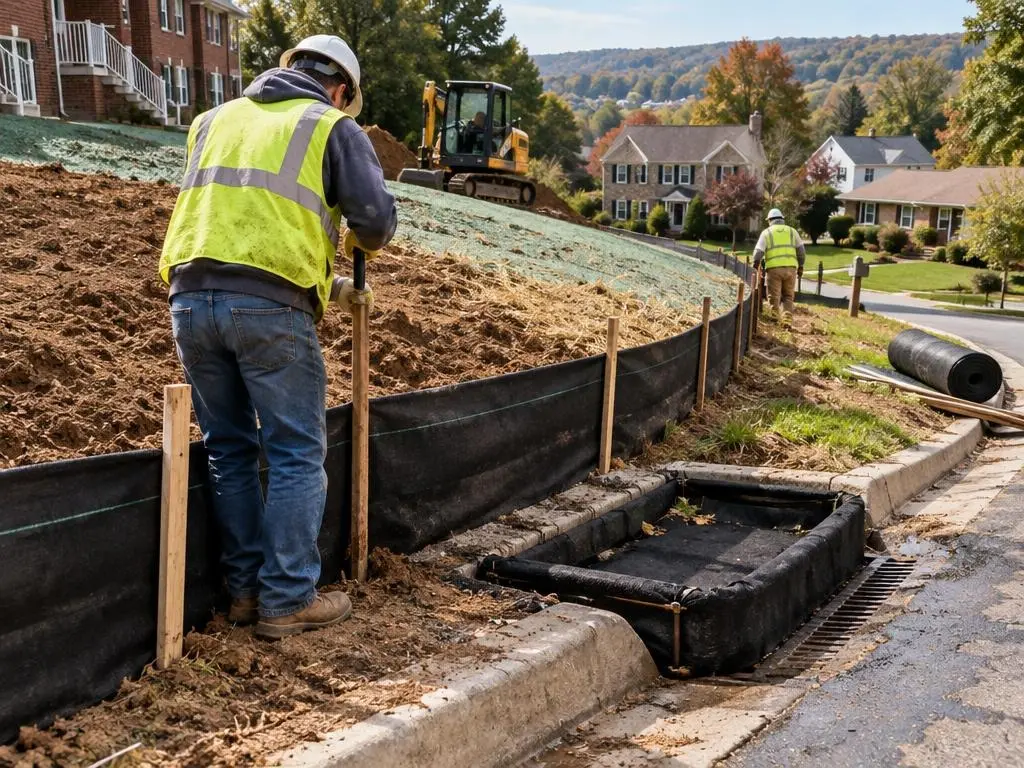
Drainage swales are often the first thing to wash out on a new lot because they are built to carry water. We seed and blanket the channel, then hydromulch the side slopes. Stormwater basins get the same treatment on their banks. Where the plan calls for permanent turf reinforcement or riprap, we coordinate with the site contractor.
Creek-side and wooded properties
The Wissahickon, Pennypack, Neshaminy, Perkiomen and Brandywine valleys all have homes on steep ground above the water. On those lots we favor shade-tolerant fine fescue mixes, keep mulch rates high and avoid disturbing tree roots any more than needed. Where a homeowner wants something other than turf, native grass and wildflower seeding can go on a stabilized bank; University of Delaware Extension advises meadow seedings go in no later than October 31 in fall or May 31 in spring.
Matching the method to the slope
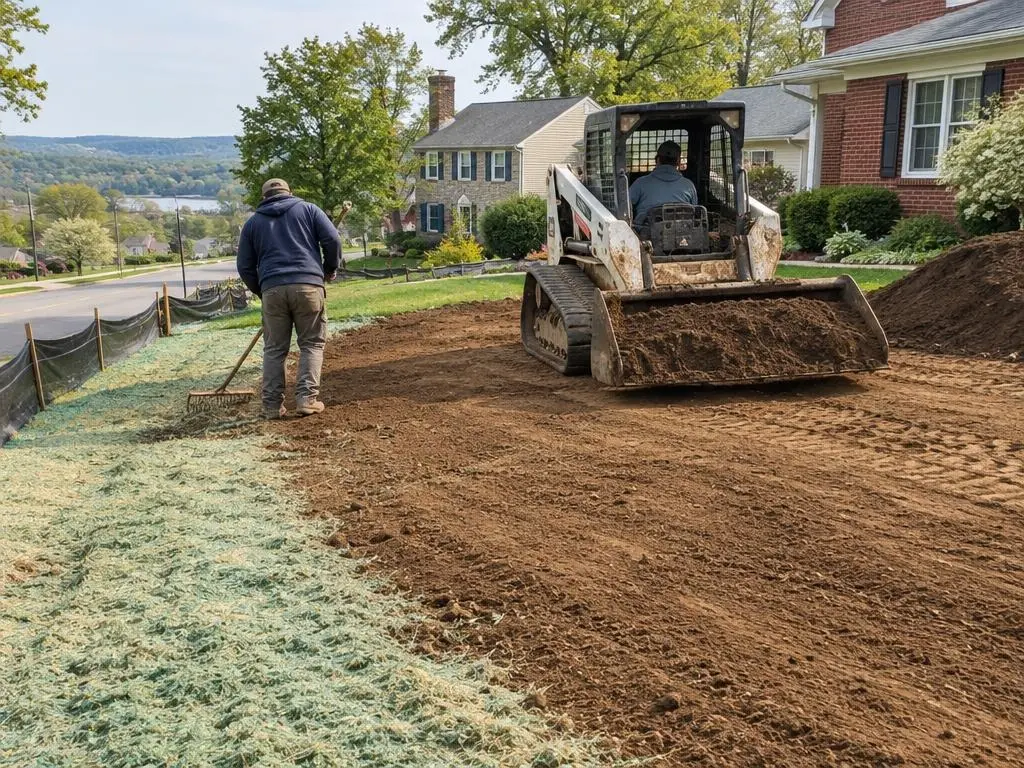
A quick rule we use on the site visit: gentle yard slopes take a standard lawn hydroseed, moderate banks take heavy hydromulch with extra tackifier, steep or long slopes take BFM or blankets, and channels take blankets. The written estimate shows which treatment goes where.
Erosion Control Options
The right cover for each grade and flow condition.
Heavy hydromulch
Higher-rate wood fiber mulch with tackifier over seed on moderate slopes.
Bonded fiber matrix
Spray-on mat with strong bonding for steep or rocky slopes.
Straw erosion control blankets
Short-term blankets for yard banks and gentle swales.
Straw-coconut and coir blankets
Longer-lasting blankets for steep banks and channels.
Swale and ditch lining
Seeded and blanketed channels that carry water without cutting.
Washout repair
Filling rills and gullies, re-seeding and re-covering damaged slopes.
Erosion Control Price References
| Item | Published figure (source) |
|---|---|
| Hydromulch of wood fiber, per 1,000 sq ft (a highway agency's 2025 erosion rates) | $98 |
| Hand-spread straw mulch, per 1,000 sq ft (same list) | $170 |
| Straw/coconut blanket (70/30 blend), per 1,000 sq ft (same list) | $468 |
| Blanket made fully of coir, per 1,000 sq ft (same list) | $532 |
| Extra for steep ground when hydroseeding, per sq ft (HomeGuide) | $0.05 to $0.10 |
| Bonded fiber matrix | Quoted on site |
The rate-list lines come from a highway agency's 2025 erosion rates, not from Philadelphia work. Slope length, access and the material chosen move the total, and we charge what our signed quote says.
How We Stabilize a Slope
1. Look at the water
We trace the runoff back to its source and mark where it gathers.
2. Repair and shape
Fill rills, smooth the face and trench the blanket tops.
3. Seed
A mix suited to sun, shade and the purpose of the slope.
4. Cover
Heavy hydromulch, BFM or stapled blankets, as the estimate specifies.
5. Check after storms
We look at the slope after early heavy rains and fix weak spots.
Why Choose Us for Slope Stabilization & Erosion Control
Treatment by zone
Not one product for the whole slope; each section gets what its pitch needs.
Blanket installs done right
Trenched tops, overlaps shingled downhill and staples in full contact.
Shade-aware seed
Fine fescue mixes for wooded creek lots.
Slope Stabilization & Erosion Control Questions
Hydromulch or blanket: which do I need?
It depends on steepness, slope length and whether water concentrates there. Moderate yard banks usually hold with heavy hydromulch. Steep banks and channels usually need blankets or bonded fiber matrix.
Will the blankets on my slope need to come out later?
Straw and coir both decompose with time while the grass grows up through them, and the photodegradable netting some blankets carry breaks down too. We explain what to expect from whichever product goes on your slope.
Can you fix a slope that already has gullies?
Yes. We fill and compact the gullies, reshape the face, address where the water is coming from, then seed and cover the slope.
Can I plant native grasses or wildflowers on a bank?
Often, yes, especially on banks that are hard to mow. They need the same erosion cover while they establish. Fall seedings should go in by the end of October.
Are you erosion control contractors for builders too?
Yes. We install blankets, hydromulch and BFM on development sites to the approved E&S plan, as well as on residential slopes.
Slope Stabilization & Erosion Control Service Areas
- Hydroseeding in Philadelphia, PA
- Hydroseeding in Doylestown, PA
- Hydroseeding in Newtown, PA
- Hydroseeding in Warminster, PA
- Hydroseeding in Bensalem, PA
- Hydroseeding in Levittown, PA
- Hydroseeding in Lower Makefield, PA
- Hydroseeding in Horsham, PA
- Hydroseeding in Lansdale, PA
- Hydroseeding in Montgomery Township, PA
- Hydroseeding in Whitpain Township, PA
- Hydroseeding in Upper Merion, PA
- Hydroseeding in West Chester, PA
- Hydroseeding in Phoenixville, PA
- Hydroseeding in Downingtown, PA
- Hydroseeding in Upper Providence, PA
- Hydroseeding in Cherry Hill, NJ
- Hydroseeding in Warrington, PA
- Hydroseeding in Concord Township, PA
- Hydroseeding in Newtown Square, PA
- Hydroseeding in Northampton Township, PA
- Hydroseeding in Evesham Township, NJ
- Hydroseeding in Upper Dublin, PA
Get a Slope Stabilization & Erosion Control Estimate
Free slope and drainage assessments in the Philadelphia area.