
Acres, not square feet
Commercial & Builder Hydroseeding in Philadelphia, PA
Temporary and permanent seeding for development sites, utility corridors and public grounds.
- We visit the property and put the price in writing at no charge
- Quotes list prep, seed mix, mulch and erosion controls separately
- Seed mixes picked for your sun, shade and soil
Seeding That Closes Out a Site
Commercial and builder hydroseeding in Philadelphia covers the large and the regulated: subdivision lots and common areas, warehouse and retail pads, stormwater basins, school grounds, utility corridors and road shoulders. Site work in the region usually ends with a seeding requirement written into the erosion and sediment control plan, and we are one of the hydroseeding companies general contractors and developers call to meet it. We bring tank capacity, hose and gun reach, and crews who understand what an inspector is looking for.
Why stabilization is on the schedule
Pennsylvania's erosion rules set the finish line. Under 25 Pa. Code 102.22, a disturbed area is permanently stabilized only when it carries a minimum uniform 70 percent perennial vegetative cover, or another approved practice, dense enough to resist accelerated erosion. Until then, temporary erosion and sediment controls have to stay in and be maintained. The same section requires disturbed ground to be seeded, mulched or otherwise protected right away when work will stop for more than 4 days. On a phased job that means seeding stockpiles, rough-graded pads and finished sections in stages instead of waiting for the end.
City projects
The Philadelphia Water Department's stormwater manual applies post-construction stormwater rules to projects with 15,000 square feet or more of earth disturbance, or 5,000 square feet inside the Darby and Cobbs Creeks watershed, and requires an Erosion and Sediment Control Plan once disturbance reaches 5,000 square feet. Its construction guidance says approved E&S measures must be installed and inspected before earth disturbance starts and kept working until the site is stabilized. Bioretention basins and infiltration areas also have to be protected from sediment for the full length of construction. Our seeding is often the last step that lets a general contractor close out those controls.
Temporary versus permanent seeding
Temporary seeding uses quick-cover grasses and mulch to hold soil on a pad or stockpile that will be disturbed again. Permanent seeding uses the specified mix, typically a cool-season turf or conservation blend, on finished grade. The specs on your plan drive seed species, rates, mulch type and rate, fertilizer and lime. If the plan calls for straw mulch, hydromulch, or a blanket on certain slopes, we follow it and flag anything that does not match field conditions.
Mulch rates and equipment
Penn State Extension lists hydromulch rates of 30 to 40 pounds per 1,000 square feet, roughly 900 to 1,600 pounds per acre, on level and gently sloping ground, and up to 3,000 pounds per acre on steep slopes. Higher rates on flat ground can smother seedlings, so we match the rate to the grade rather than spraying one heavy coat everywhere. Truck-mounted guns reach well into a site from the haul road, and hose runs cover basins, embankments and the backs of lots that equipment cannot reach without rutting the finished grade.
Working around other trades
On active sites we coordinate with the excavator and the paving crew so seed goes down after final grade and topsoil but before the area is driven over again. We keep slurry off curbs, inlets and fresh concrete and work around silt fence and inlet protection, or install and maintain those controls ourselves through our silt fence service. Large jobs can be split into phases, with each area documented when it is seeded.
Public and institutional work
Schools, parks departments, churches, cemeteries and homeowner associations bring their own needs: wide open fields, heavy foot traffic once the grass is in, and timing around use. Penn State notes higher seeding rates are sometimes used when a quick, dense stand is needed or the turf will take heavy wear, but that heavier rates alone can increase disease. We size the mix and rate to how the ground will be used.
Pricing large areas
Acreage pricing depends on access, mulch type and rate, seed specification, slope and how many mobilizations the schedule needs. Published consumer guides put hydroseeding at roughly $2,000 to $8,700 per acre depending on the source, and public bid tabulations give a sense of contractor pricing on open ground. We price from your plan set and a walk of the site.
Commercial Seeding Work
Seeding and stabilization for sites of any size.
Permanent site seeding
Specified seed mixes on finished grade to reach full vegetative cover.
Temporary stabilization
Fast cover on stockpiles, pads and phases that will be disturbed again.
Stormwater basins and swales
Seeding of basin bottoms, side slopes and conveyance swales to plan specs.
Utility and road corridors
Long, narrow restoration strips seeded from the truck or by hose.
Subdivision lots and common areas
Builder lots, open space and entrance areas seeded in phases.
Athletic and institutional grounds
Fields and campus lawns seeded for wear and timed around use.
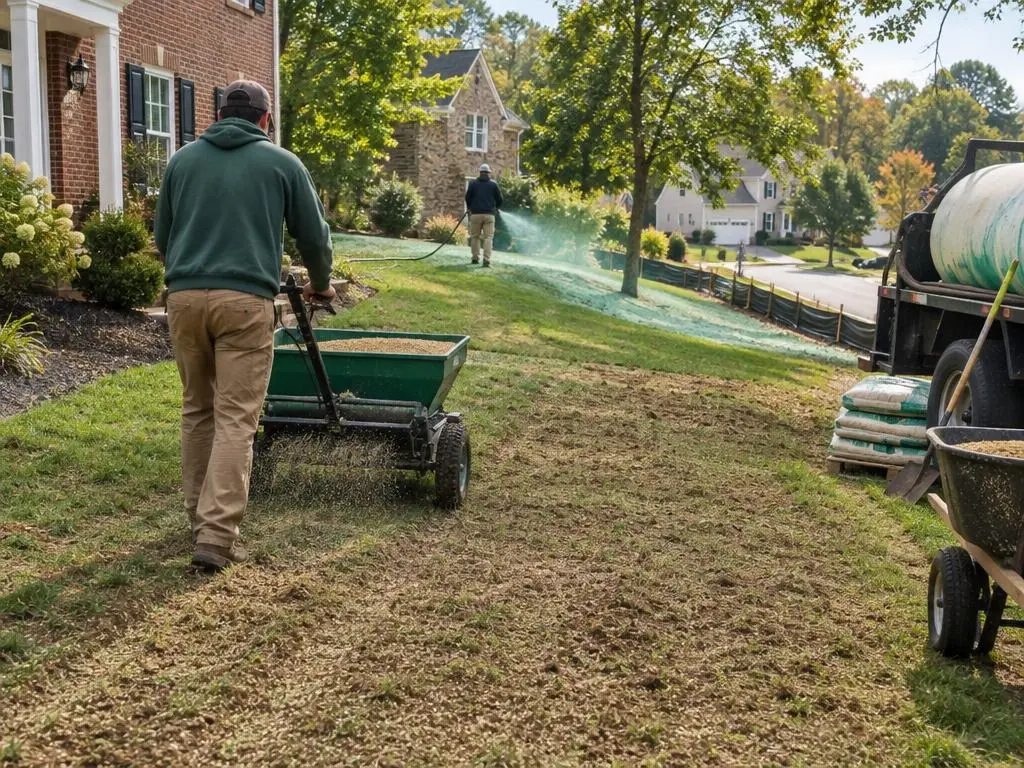
Large-Area Hydroseeding Prices
| Measure | Published figure (source) |
|---|---|
| Hydroseeding per acre (LawnStarter) | $2,136 to $4,897 |
| Hydroseeding per acre (Fixr) | $2,000 to $4,000 |
| One acre (HomeAdvisor) | $2,600 to $8,700 |
| One acre (HomeGuide) | $5,000 to $8,500 |
| Two 2023 municipal bids per acre (North Little Rock, Arkansas) | $2,595 and $3,325 |
Consumer-guide figures plus one 2023 public bid, listed for reference only. Specs, access, phasing and the number of mobilizations all shift the cost; we bill the figure on the quote we sign with you.
From Plan Set to Cover
1. Plan review
We read the E&S and landscape sheets for seed, mulch, lime and fertilizer specs.
2. Site walk
We check grade, topsoil, access, water source and phasing with your superintendent.
3. Estimate and schedule
Written price per area or per mobilization, booked to your sequence.
4. Seed and mulch
Application to spec, with inlets, curbs and controls protected.
5. Follow-up
We check coverage and touch up thin or washed areas so you can reach the cover standard.
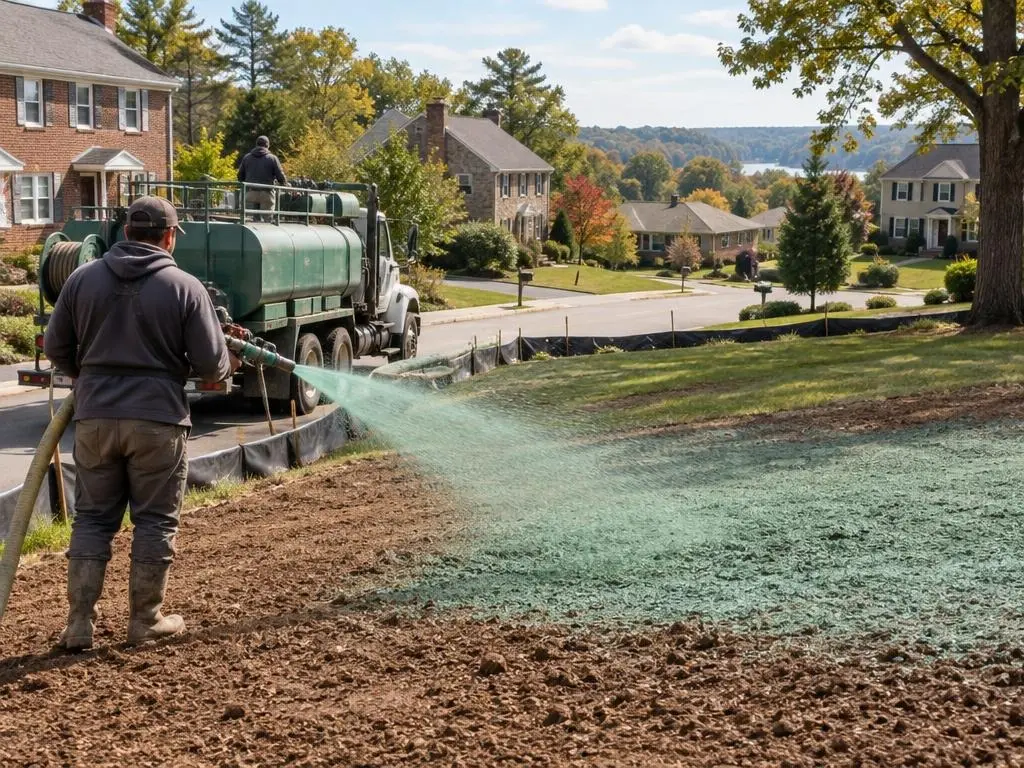
Why Choose Us for Commercial & Builder Hydroseeding
Spec-driven
We seed to your approved plan, not to a generic mix.
Phase-friendly
Multiple mobilizations for staged sites and the 4-day temporary rule.
Controls handled together
Silt fence, inlet protection and blankets can go on the same contract.
Clean work
Slurry kept off curbs, inlets and fresh concrete.
Commercial & Builder Hydroseeding Questions
Do you work as a subcontractor to general contractors?
Yes. Most of our commercial seeding is for builders, site contractors and developers, and we work to their schedule and plan set.
What counts as stabilized in Pennsylvania?
Under 25 Pa. Code 102.22, permanent stabilization means a minimum uniform 70 percent perennial vegetative cover, or another approved practice, dense enough to resist erosion. Temporary controls stay until that is reached.
Can you seed in phases as areas are finished?
Yes. Phased seeding is common and helps meet the rule that ground idle for more than 4 days be seeded or mulched. Each mobilization is priced in the estimate.
What do hydroseeding contractors need from us before arriving?
Finished grade and topsoil in the areas to be seeded, access for the truck or a hose route, a water source if one is available on site, and the seed and mulch specs from the plan.
Do you do winter seeding?
Seed will not germinate in cold soil, so late-fall and winter work is usually mulch-only or temporary cover, with permanent seeding when the season allows. We follow what your plan requires for off-season stabilization.
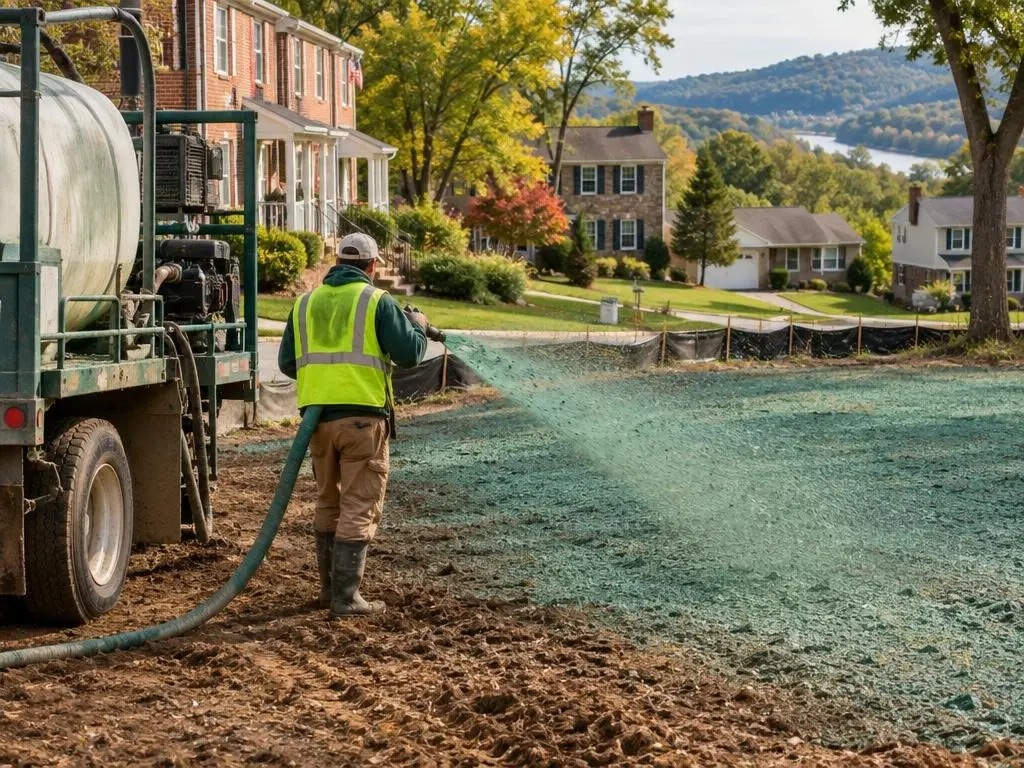
Commercial & Builder Hydroseeding Service Areas
- Hydroseeding in Philadelphia, PA
- Hydroseeding in Doylestown, PA
- Hydroseeding in Newtown, PA
- Hydroseeding in Warminster, PA
- Hydroseeding in Bensalem, PA
- Hydroseeding in Levittown, PA
- Hydroseeding in Lower Makefield, PA
- Hydroseeding in Horsham, PA
- Hydroseeding in Lansdale, PA
- Hydroseeding in Montgomery Township, PA
- Hydroseeding in Whitpain Township, PA
- Hydroseeding in Upper Merion, PA
- Hydroseeding in West Chester, PA
- Hydroseeding in Phoenixville, PA
- Hydroseeding in Downingtown, PA
- Hydroseeding in Upper Providence, PA
- Hydroseeding in Cherry Hill, NJ
- Hydroseeding in Warrington, PA
- Hydroseeding in Concord Township, PA
- Hydroseeding in Newtown Square, PA
- Hydroseeding in Northampton Township, PA
- Hydroseeding in Evesham Township, NJ
- Hydroseeding in Upper Dublin, PA
Get a Commercial & Builder Hydroseeding Estimate
Send us your plan set for a written site seeding price.